
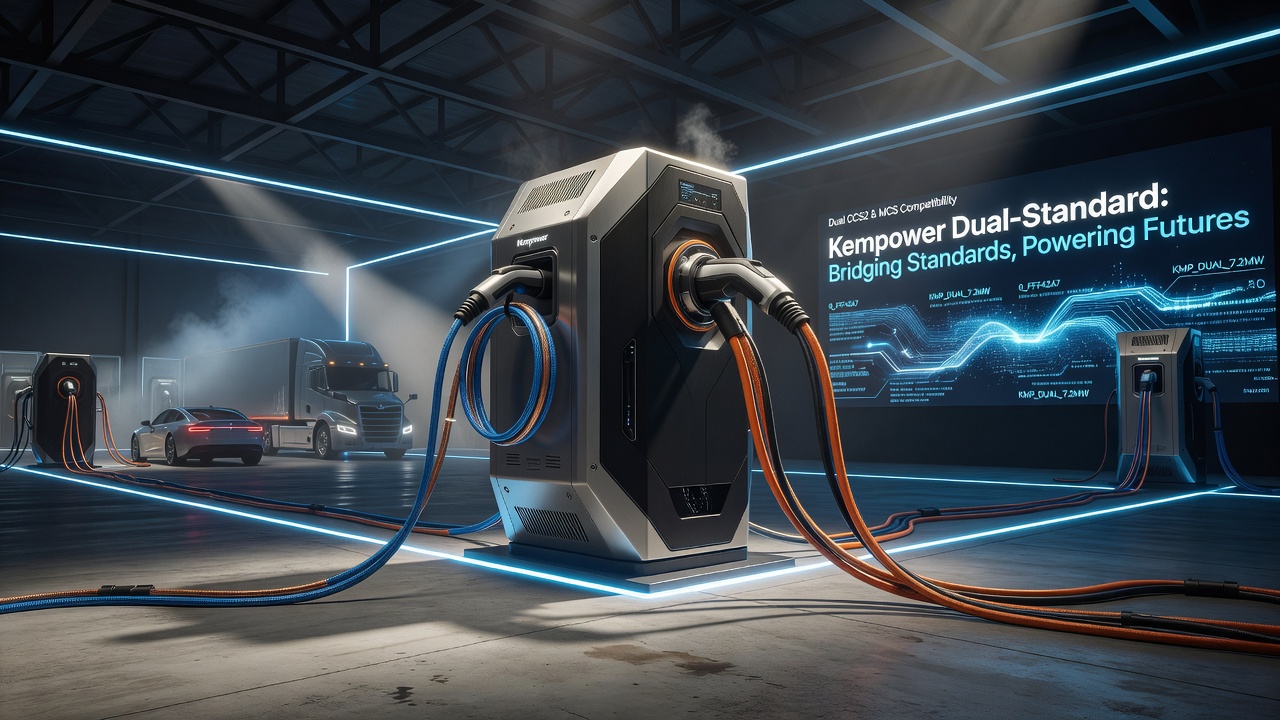
Kempower has introduced a charging unit designed to solve one of the electric-vehicle industry's more expensive headaches: building separate infrastructure for cars and trucks. The new Mega Satellite Flex supports both the established CCS standard, at up to 560 kW, and the emerging Megawatt Charging System, at up to 1.2 MW, from a single dispenser. It's the Finnish company's first product to offer operators a choice between the two standards on one machine, rather than forcing a commitment to one or the other.
The timing reflects where the industry actually stands. CCS remains the dominant standard for passenger EVs across North America and Europe, while MCS is still being rolled out specifically for heavy-duty trucks that require far higher power levels to make long-haul electric transport practical. Fleet operators and charging-site owners have effectively had to choose a side, often building infrastructure for one vehicle class and hoping the market doesn't shift underneath them. Questions like whether you can still be tracked with a VPN might seem unrelated to charging hardware, but both point to a similar dynamic: as connected technology expands, so does the number of touchpoints - data or electrical - that need to be secured and managed responsibly. whether you can still be tracked with a VPN
One Site, Two Standards
The practical appeal for operators is straightforward. Instead of installing one set of chargers for cars and a separate, costlier setup for trucks, a single Mega Satellite Flex unit can serve both from the moment it's switched on. That eliminates the need for a second construction phase later, when truck-charging demand catches up with passenger EV demand - a gap that has left many charging sites underused during the transition years. Kempower says the unit also supports 800-volt EV architectures, an increasingly common design in newer passenger and commercial vehicles that allows for faster charging when paired with compatible hardware.
The Specifications Behind the Flexibility
The technical details explain how the unit manages such a wide range of power delivery. The Mega Satellite Flex handles up to 1,500 amps on the MCS side and 700 amps for CCS, with cable lengths of 5 meters for CCS connections and 2.7 meters for MCS. An optional payment terminal can be built into the unit, and it's designed to integrate with Kempower's existing distributed charging architecture, meaning operators who already use Kempower systems won't need to redesign their sites to accommodate it.
What It Means for Charging Economics
Utilization is the real story here. A charging site earns money when its hardware is in use, not when it's sitting idle waiting for the right vehicle type to show up. By serving both CCS and MCS vehicles from day one, operators can capture revenue from whichever segment of the market grows faster in their region, without betting the entire investment on one outcome. That flexibility matters most during exactly the kind of transitional period the trucking industry is now in, where MCS infrastructure is still sparse but demand for it is expected to climb sharply over the coming years.
Kempower revealed the Mega Satellite Flex at its Unplug & Recharge event held alongside ACT Expo, where the unit is on display this week. The company expects it to reach the North American and European markets in July 2026, giving fleet operators and charging-network developers over a year to plan deployments around a technology built explicitly for the uncertainty of the current charging standard.