
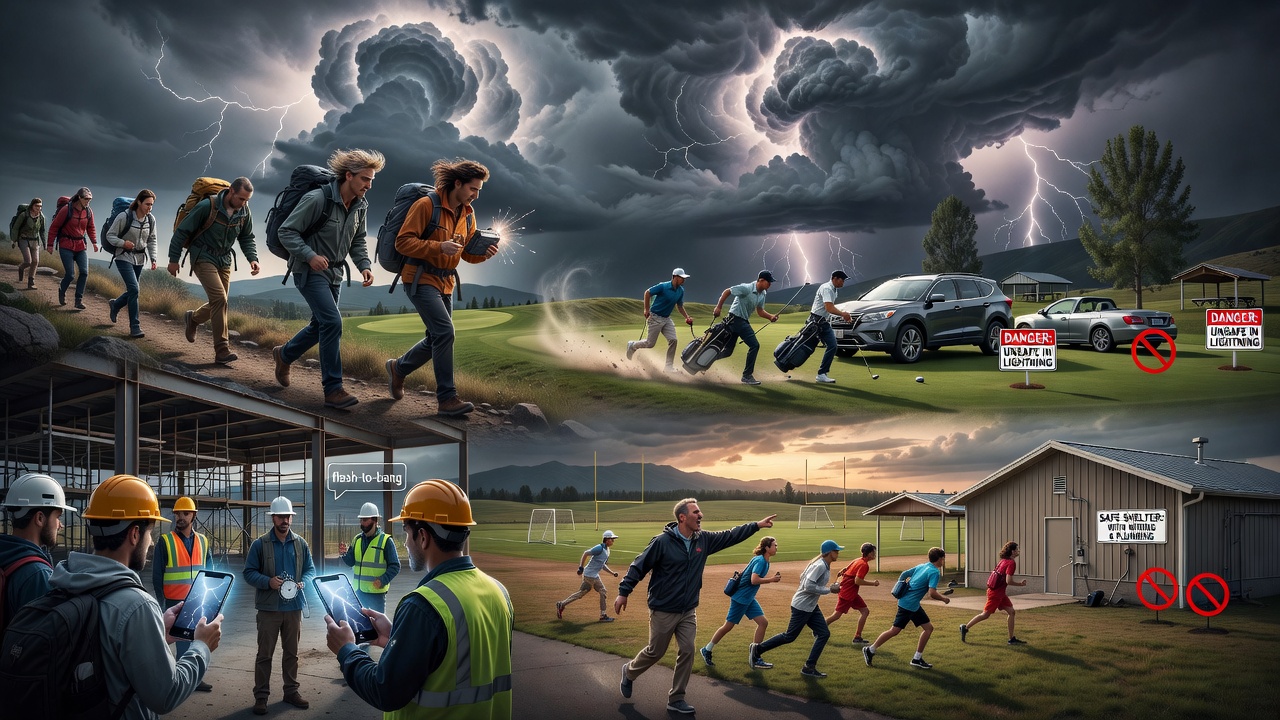
Lightning kills more people in an average year than tornadoes, and most victims are struck not during the peak of a storm but in the thirty minutes before it arrives or the thirty minutes after it seems to have passed. That window of false confidence is where the real danger lives. A clear sky overhead means nothing if a storm cell is building ten miles away, because lightning can travel far outside the rain shaft that spawns it.
Anyone who spends time outdoors - hikers, golfers, coaches, construction crews, campers - needs a working understanding of how lightning behaves and how to respond before the first flash appears. This is not a topic where instinct serves you well; the instinct to keep playing golf until the rain starts, or to wait under a tree "just for a minute," is precisely what gets people hurt. Before diving into the mechanics of storm behavior, it's worth knowing that even entertainment platforms have picked up on the drama of electrical storms - some slot games are literally themed around them, and reviewing something like lightning storm rules on a gaming site is a harmless curiosity compared to ignoring real lightning storm safety rules outdoors. The stakes in nature are considerably higher than in any game.
This piece walks through how to recognize thunderstorm warning signs early, what lightning strike prevention actually requires in practice, how to build a personal or group emergency lightning protocol, and where to find real shelter when a storm catches you in the open.
Understanding How Lightning Forms and Why It's So Dangerous
Lightning is a byproduct of convection. Warm, moist air rises rapidly inside a developing cumulonimbus cloud, colliding with ice crystals and water droplets in a process that separates electrical charge. Positive charge tends to accumulate near the top of the cloud, negative charge near the base. When the difference becomes great enough, the atmosphere breaks down and a channel of superheated plasma - the visible bolt - connects cloud to ground, cloud to cloud, or cloud to surrounding air.
The danger isn't limited to a direct hit. A strike can travel through the ground for a significant distance, through water, through metal fencing or plumbing, or as a "side flash" jumping from a taller object - a tree, a pole - to a person standing nearby. Understanding this spread is central to lightning strike prevention, because it explains why standing near a tall isolated object is dangerous even without direct contact.
The Physics Behind a Strike
A single lightning bolt can heat the surrounding air to temperatures several times hotter than the surface of the sun, causing the rapid expansion we hear as thunder. The temperature differential and shockwave are what produce the crack and rumble, and the time delay between flash and sound is a direct measure of distance, since light travels essentially instantaneously while sound moves at roughly one mile per five seconds.
Why Open Areas and Water Increase Risk
Electricity seeks the path of least resistance to ground. In open terrain, a standing human body - being taller than surrounding grass or shrubs - can become that path. Water conducts electricity efficiently and offers no elevation advantage to any single point, which is why boaters, swimmers, and anglers face outsized risk during storm activity.
Recognizing Thunderstorm Warning Signs Before the Storm Arrives
Most lightning injuries happen to people who saw the signs and decided to keep going anyway. Learning to read the sky and the air is a skill that pays off far more reliably than any last-minute sprint for cover.
Visual and Atmospheric Cues
Towering cumulus clouds with hard, cauliflower-like edges building vertically are the clearest early indicator. A darkening base, an anvil-shaped top, or a sudden drop in temperature accompanied by a gusty outflow wind all signal that a cell is maturing quickly. Static on an AM radio, a tingling sensation on the skin, or hair standing on end are late-stage warnings - at that point, a strike may be imminent within seconds.
The 30-30 Rule
One of the most reliable field heuristics remains the 30-30 rule: if the time between seeing lightning and hearing thunder is thirty seconds or less, seek shelter immediately. Wait thirty minutes after the last audible thunderclap before resuming outdoor activity. This single guideline accounts for a large share of effective lightning storm safety rules used by outdoor organizations, sports leagues, and park services.
- Flash-to-bang count of 30 seconds or less means the storm is within roughly six miles - close enough to strike
- Thunder heard at all, even faintly, means you are within striking distance
- A thirty-minute wait after the final thunder is non-negotiable, since trailing cells often produce isolated strikes
Using Forecasts and Real-Time Alerts
Modern weather radar and lightning-detection networks give a meaningful head start. Checking a forecast before heading out, and monitoring radar apps that show real-time strike data during an activity, turns a reactive posture into a proactive one. Coaches and event organizers increasingly build this monitoring directly into pre-event planning rather than treating it as an afterthought.
Core Lightning Strike Prevention Strategies
Prevention is less about heroics and more about discipline - leaving early, avoiding exposed terrain, and respecting thresholds that feel overly cautious in the moment.
Timing Outdoor Activities Around Storm Risk
Afternoon and early evening are peak hours for thunderstorm development in most temperate climates, driven by daytime heating. Scheduling strenuous or exposed outdoor activity for the morning, when atmospheric instability is typically lower, reduces exposure without requiring any special equipment or training.
Avoiding High-Risk Terrain and Objects
Ridgelines, open fields, isolated trees, metal fences, and elevated structures all increase relative risk. A hiker on an exposed summit is in one of the worst possible positions during an approaching storm and should descend well before the 30-30 threshold is reached, not after.
Personal Gear and Group Planning
Removing metal jewelry, avoiding umbrellas with metal ribs, and separating group members by several yards to reduce the chance of multiple casualties from a single strike are all practical, low-cost prevention measures. Groups traveling together - sports teams, scout troops, work crews - benefit from designating one person whose sole job is monitoring the sky and enforcing the group's threshold for retreat.
Building an Emergency Lightning Protocol for Groups and Individuals
A protocol only works if it's decided in advance, written down, and rehearsed. Deciding what to do while lightning is already flashing overhead is decision-making under the worst possible conditions.
Establishing Clear Trigger Points
An effective emergency lightning protocol defines, in advance, exactly what observation triggers action - a flash-to-bang count, a specific radar distance, or a designated spotter's call. Ambiguity is the enemy here; "we'll head in if it looks bad" is not a protocol, it's a hope.
Roles and Communication During an Evacuation
Larger groups, especially at organized events, benefit from assigning specific roles: one person to call the evacuation, one to account for headcount at the shelter point, one to monitor conditions for the all-clear. Radios or phones with a shared group chat reduce confusion when visibility or noise makes shouting instructions ineffective.
Post-Storm Reassembly and Injury Checks
Once the thirty-minute clearance window has passed, a good protocol includes a headcount and a basic check for anyone who may have been affected by a nearby strike - confusion, burns, or cardiac symptoms can appear even from a near-miss and warrant immediate medical attention.
Outdoor Lightning Shelter Guidelines: Where to Actually Go
Not all shelter is created equal, and the difference between adequate and inadequate shelter is often the difference between a scare and a fatality.
Substantial Buildings and Hard-Topped Vehicles
A fully enclosed building with wiring and plumbing is the gold standard, since the electrical systems provide a path to ground that bypasses occupants. A hard-topped vehicle with the windows rolled up is the next best option - the metal frame, not the tires as commonly believed, conducts current around the interior.
What Does Not Count as Real Shelter
Picnic shelters, dugouts, small gazebos, and lone trees offer psychological comfort but little real protection. These outdoor lightning shelter guidelines apply across recreational settings: golf courses, campgrounds, and sports fields routinely lack adequate shelter, which is why leaving the area entirely is often the only sound option.
- Avoid open-sided pavilions and covered picnic areas - they do not block side flashes or ground current
- Never shelter under an isolated tree; it's among the most dangerous places to stand
- Convertible or soft-top vehicles offer no meaningful protection
- Caves without depth can channel dangerous ground current across the entrance
If No Shelter Is Available
When no building or vehicle is reachable, the guidance is to minimize contact with the ground and avoid being the tallest point in the landscape. Crouching low, on the balls of the feet, with feet together, reduces the potential path length for ground current through the body. This is a last resort, not a strategy to rely on, and it does not eliminate risk.
Special Considerations for Different Outdoor Activities
Risk profiles shift depending on what you're doing and where, and a one-size-fits-all approach misses important detail.
Water-Based Recreation
Boaters, kayakers, and swimmers should treat any distant rumble as a mandatory exit signal, since water offers zero shelter and sound often carries poorly across open water, masking how close a storm actually is.
Team Sports and Organized Events
Youth sports leagues have increasingly adopted formal lightning storm safety rules requiring games to stop and fields to clear at the first flash-to-bang trigger, regardless of score or schedule pressure. Coaches who resist these stoppages put entire rosters at risk for the sake of a few minutes of play.
Backcountry and Remote Hiking
Hikers face the added complication of distance from any real shelter. Planning routes to be off exposed ridgelines by early afternoon, and building in flexible turnaround times based on morning forecasts, does more to prevent injury than any gear choice made after a storm is already visible.
Frequently Asked Questions
Can lightning strike from a clear blue sky?
Yes. Lightning can travel horizontally from a storm cell and strike ground ten miles or more from the parent cloud, often referred to as a "bolt from the blue." This is why hearing distant thunder should trigger shelter-seeking even if the sky directly overhead looks calm.
Is it safe to use a phone or shower during a thunderstorm indoors?
A corded landline phone and plumbing fixtures can conduct a strike that hits the building's electrical or water systems, so it's best to avoid both during active storms. Cordless and mobile phones not connected to a wall are generally fine to use indoors.
How close does lightning need to be for the 30-30 rule to apply?
A flash-to-bang count of thirty seconds or less indicates the storm is within about six miles, which is close enough for a strike to reach your location. At that point the rule calls for immediate shelter, not a wait-and-see approach.
Does lying flat on the ground reduce lightning risk?
No, and this is a common misconception. Lying flat increases the surface area of your body in contact with the ground, which can increase exposure to ground current spreading from a nearby strike; crouching low with minimal ground contact is the safer last-resort position.
Are rubber-soled shoes or rubber tires protective against lightning?
No. The insulation offered by shoe soles or tires is negligible compared to the millions of volts involved in a lightning strike. Vehicle safety comes from the metal frame directing current around the cabin, not from the tires.
How long after thunder stops is it actually safe to go back outside?
Wait a full thirty minutes after the last thunderclap, not the last visible flash. Trailing storm cells frequently produce isolated strikes well after the main rain has passed, which is why this waiting period is a core part of established emergency lightning protocol.