
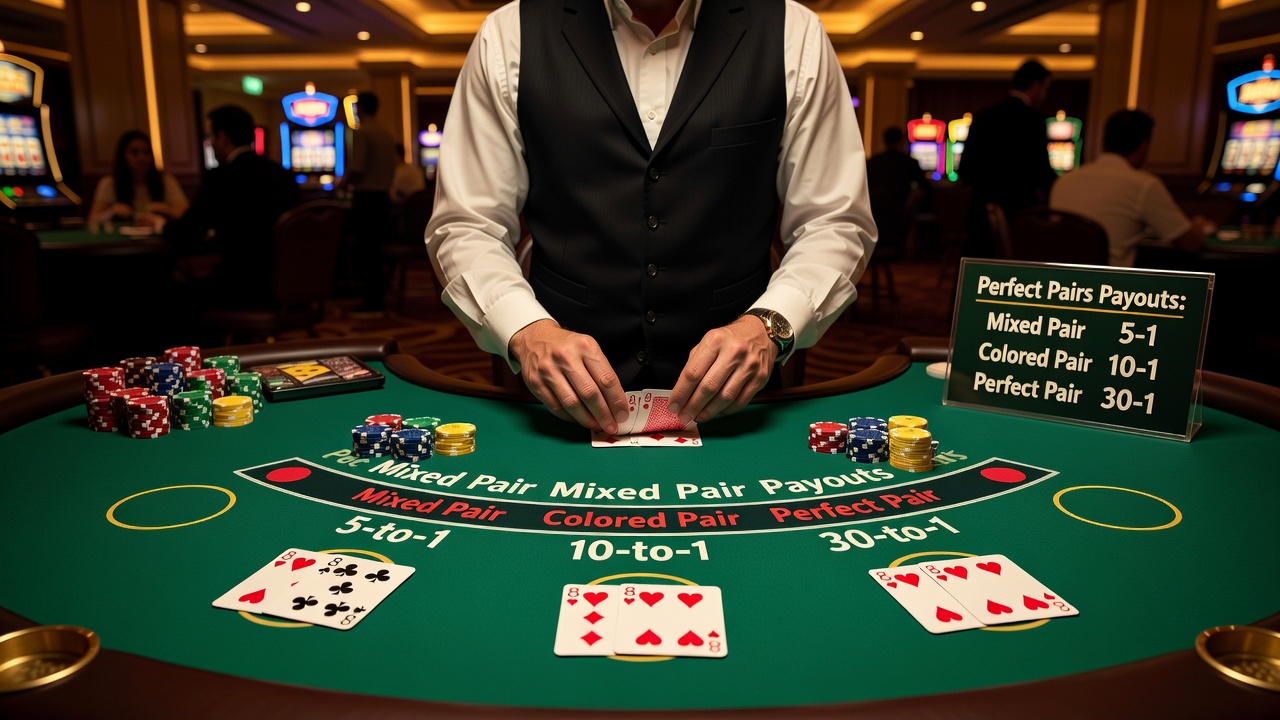
A single hand of Perfect Pairs blackjack pays anywhere from 5-to-1 to 30-to-1 depending on the pairing you hit - and most players placing that side bet have no idea which outcome they're actually betting on. That gap between hope and math is where casinos build their edge. Perfect Pairs looks simple on the felt: match your first two cards, collect a payout. But the size of that payout swings wildly based on whether the pair is mixed, matching in color, or an identical suited pair, and the difference between a mediocre paytable and a strong one can shift the house edge by several percentage points.
Most guides gloss over this distinction, treating the side bet as a single flat wager rather than three separate outcomes with three separate probabilities. Understanding the real structure behind perfect pairs blackjack payouts changes how you evaluate a table before you ever place a chip on the circle. A player who knows the payout tiers and their true odds can spot a favorable table in seconds, while everyone else is guessing based on gut instinct. This piece breaks down the mechanics, the math, and the decision-making that separates a disciplined side-bet player from one who's simply feeding the house.
What Perfect Pairs Blackjack Actually Is
Perfect Pairs is a side bet layered onto standard blackjack. Before the dealer deals, you place an additional wager predicting that your first two cards will form a pair. It doesn't affect your main hand or your basic strategy decisions - it resolves the instant the cards land, independent of how the rest of the hand plays out.
How the Side Bet Fits Into Standard Blackjack
The core blackjack hand proceeds exactly as it would without the side wager. You still hit, stand, double, or split based on the dealer's upcard and your total. Perfect Pairs simply sits alongside that action, settled the moment your two cards are revealed, win or lose, before a single additional card is drawn.
The Three Payout Tiers Explained
Nearly every version of the bet splits winning pairs into three categories:
- Mixed pair - same rank, different colors (e.g., 8 of hearts and 8 of clubs)
- Colored pair - same rank, same color, different suit (e.g., 8 of hearts and 8 of diamonds)
- Perfect pair - identical rank and suit (e.g., 8 of hearts and 8 of hearts, from separate decks)
Each tier carries its own multiplier, and the perfect pair - the rarest of the three - pays the most.
Why Casinos Offer This Bet
Side bets like this exist because they carry a higher house edge than the main game, often between 3% and 11% depending on the paytable and deck count. Casinos use them to boost table revenue without altering the core game that experienced players already trust.
Perfect Pairs Blackjack Odds: The Real Math
Perfect pairs blackjack odds depend heavily on how many decks are in play. More decks in the shoe actually increase the raw number of possible pairing combinations, but they also increase the total number of two-card combinations overall, so the relationship between deck count and probability isn't always intuitive.
Single-Deck vs Multi-Deck Probability Shifts
In a single-deck game, there are fewer cards of any given rank available, which limits pairing opportunities but also concentrates them. In a six- or eight-deck shoe - the industry standard for most Perfect Pairs tables - the odds stabilize somewhat, but the perfect pair (identical suit) becomes proportionally harder to hit relative to mixed pairs, since there are more non-matching suit combinations diluting the pool.
Probability of Each Pair Type
Across a standard multi-deck shoe, mixed pairs occur far more often than colored pairs, and colored pairs occur far more often than perfect pairs. The rough hierarchy holds consistently: mixed pairs make up roughly half of all winning pair outcomes, colored pairs a smaller share, and perfect pairs the smallest share by a wide margin. This is precisely why the payout structure is tiered instead of flat.
How Deck Count Changes the House Edge
Fewer decks generally tighten the odds slightly in the player's favor on this specific bet, though the effect is modest compared to how deck count influences the main blackjack game. Still, if you're deciding between two tables offering the same paytable, the one with fewer decks in the shoe is usually the marginally better choice for the side bet.
Optimal Pair Blackjack Payouts by Paytable Version
Not all Perfect Pairs tables are created equal. Paytables vary by casino, and the difference between a generous version and a stingy one can be the difference between a side bet worth considering and one worth skipping entirely.
Common Paytable Structures
A frequently seen structure pays 5-to-1 for a mixed pair, 10-to-1 for a colored pair, and 30-to-1 for a perfect pair. Other variants adjust these figures downward - 5/10/25, for instance - trimming the top payout to widen the house's margin. Some tables even fold in a bonus tier for suited three-of-a-kind or other rare combinations, though these are less common and typically found on proprietary or branded versions of the game.
Identifying the Optimal Pair Blackjack Payouts Table
The optimal pair blackjack payouts setup, from a player's standpoint, maximizes the perfect pair payout without inflating the house edge elsewhere. Look for the 5-10-30 structure specifically - it's widely regarded as the most balanced version currently in circulation, giving the rare perfect pair its full value rather than shaving points off the top for house profit.
Reading Payout Placards at the Table
Before sitting down, glance at the payout placard next to the betting circle. It will list the three tiers explicitly. If the numbers look unfamiliar or unusually low across the board, treat that as a signal to skip the side bet at that particular table, even if the main game rules look otherwise favorable.
How to Calculate Perfect Pair Blackjack Payouts
Knowing how to calculate perfect pair blackjack payouts turns an abstract paytable into a concrete expected-value figure you can compare across casinos.
The Basic Formula
Expected value for a side bet is calculated by multiplying the probability of each outcome by its payout, summing those products, then subtracting the probability of losing (multiplied by the amount wagered). In simple terms: (probability of mixed pair × mixed payout) + (probability of colored pair × colored payout) + (probability of perfect pair × perfect payout) − (probability of no pair × 1).
Working Through a Sample Calculation
Take a six-deck shoe with a 5-10-30 paytable. If the probability of any pair landing is roughly 1 in 17 hands, and within that pool mixed pairs account for about half, colored pairs about a third, and perfect pairs the remainder, you can plug each fraction into the formula above. The resulting expected value will land in negative territory - as it does for virtually every side bet - but the magnitude of that negative number tells you exactly how much the house edge costs you per dollar wagered over time.
Comparing Paytables Using Expected Value
Once you've calculated expected value for one paytable, repeat the process for a second version with different multipliers. The table producing the smaller negative number is mathematically the better bet. This comparison is the single most useful exercise a player can do before committing real money to the side bet.
Perfect Pairs Blackjack Payout Rules You Need to Know
Beyond the math, there are procedural rules that govern how and when the bet resolves, and missing these details can lead to confusion at the table.
Timing and Placement Requirements
The side bet must be placed before the initial deal - there's no opportunity to add it once cards are in play. It's typically wagered in a designated circle adjacent to your main bet, and most casinos set a minimum and maximum limit on it independent of the main game's limits.
Settlement Rules and Split Hands
Perfect pairs blackjack payout rules generally state that the bet settles based solely on your original two cards, regardless of what happens afterward. If you split a pair into two hands, the side bet already resolved before the split occurred - it doesn't duplicate or apply separately to each new hand.
Variations Across Casino Software and Live Tables
Rules can differ slightly between live dealer tables and digital versions, particularly around bonus payouts for rare combinations like three-of-a-kind pairs across multiple hands at the table. Always check the specific rule sheet, either physical or digital, before assuming a standard structure applies.
Best Strategy for Perfect Pairs Blackjack
There's no skill-based decision once the bet is placed - the outcome is fixed by the deal. So strategy here means bet selection and bankroll discipline rather than in-hand choices.
Bankroll Allocation for Side Bets
Given the elevated house edge, treat Perfect Pairs as a small, capped percentage of your total blackjack bankroll - many disciplined players cap it at 5% or less of what they'd wager on the main hand. Treating it as a supplementary novelty bet rather than a primary strategy keeps losses contained.
Table Selection as the Core Strategy
The best strategy for perfect pairs blackjack isn't about reading the cards - it's about reading the paytable before you sit down. Prioritizing tables with the 5-10-30 structure over lesser variants is the single highest-leverage decision you can make regarding this bet.
When to Skip the Bet Entirely
If a table only offers a compressed paytable, or if you're already committed to a tight bankroll for the session, skipping the side bet altogether is often the mathematically sound choice. There's no rule requiring you to place it - it's entirely optional and exists independently of your main wager.
Frequently Asked Questions
Is Perfect Pairs a good bet compared to other blackjack side bets?
It falls in the middle range. Its house edge is generally lower than bets like Lucky Ladies but higher than something like insurance under specific card-counting conditions. Compared to 21+3 or Bust It, Perfect Pairs is often considered a reasonably balanced option if you're going to play a side bet at all.
Does card counting affect Perfect Pairs odds?
Tracking paired ranks is theoretically possible in single-deck or double-deck games with a very short shoe, but in standard six- to eight-deck games, the effect is negligible. The volume of cards makes meaningful edge-shifting impractical for most players.
Can I place a Perfect Pairs bet without playing the main hand?
No. Casinos require an active main wager before allowing the side bet. Perfect Pairs is structured as an add-on, not a standalone game, so you can't isolate it from the primary blackjack hand.
Why do payout tiers differ so much between mixed, colored, and perfect pairs?
The tiers reflect actual probability. Mixed pairs are common, colored pairs are less common, and true suited perfect pairs are rare, so the payout scales inversely with likelihood to keep the bet mathematically coherent.
Do online and live dealer versions of Perfect Pairs use the same paytable?
Not always. Payouts can vary by platform and by specific game provider, so it's worth checking the posted rules for each version rather than assuming consistency across every casino or app you play.
Is there a version of Perfect Pairs with better odds than the standard game?
Some tables include an extended paytable with additional bonus tiers, such as rewarding a perfect pair shared across multiple players' hands at the same table. These variants can occasionally offer marginally better value, but they're less common and worth confirming before assuming they're available.